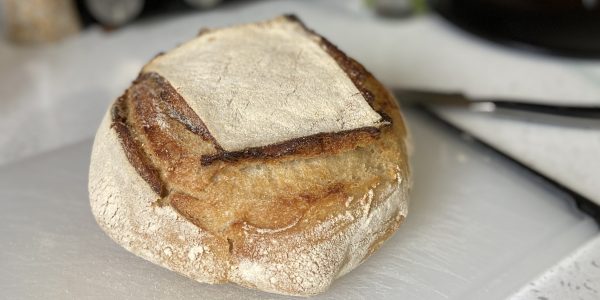
Four years ago this October, I started fermenting my sourdough starter. This was before the sourdough craze of the COVID years. I just loved to bake and it seemed like the next thing I wanted to learn. That sourdough starter has now moved with me to three different homes, from my single days, to engaged, to married, to a mother. It’s a funny little touchstone – always dwelling in the back of my fridge, emerging every couple of weeks to be mixed with some fresh water and flour to keep growing.
For a bit there, I had a regular habit of making bread once a week, on the day I worked from home (when, before COVID, I worked from home once a week). It was the perfect work from home project – the dough needed a few minutes of tending every hour or two, but it wasn’t very time intensive. It was a great excuse to stand up from my laptop, stretch, and do something with my hands for three minutes before diving back into the salt mine (as my dad would say).
Originally, I used a recipe from King Arthur Flour’s website. Then, in 2019 I was in San Francisco for a work conference and visited Tartine Bakery. I can still remember biting into their toasted slices of sourdough, butter dribbling through the giant air holes and down my chin. It was warm and had a chewy bite and understated tang unlike anything I had ever eaten. I was captivated. I quickly came home and learned how to make sourdough the Tartine way.
It’s been months since I’ve made the time to bake. Every since our sweet little Rosemary was born in May of 2022, free time is very limited. It’s been easier to buy a loaf from the grocery store than bake – even making it to the grocery store can feel like a big accomplishment. But I had a few days off this Thanksgiving week, and with Rosie finally taking some longer naps, I thought I might just give sourdough baking another try. Except, this time, I wanted to compare my original loaf with my newer favorite.
The players:
The similarities:
- Both recipes are exclusively naturally leavened – using entirely sourdough starter, without any yeast
- Both were basic loaves: flour, water, starter, and salt.
- Both were shaped similarly at the end, before the second rise, with a “letter” style fold, then a roll. Each were placed in a floured cloth or bowl with floured kitchen towel.
The differences:
- The King Arthur Flour recipe uses kneading to strengthen and develop the loaf while the Tartine recipe uses a series of folds, made right in the proofing bucket.
- The Tartine recipe has a much higher water saturation (70%) than King Arthur Flour (57%).
- The King Arthur Flour recipe allows for less time for both the first and second rise. Two hours are allotted for the first rise, two and a half for the second.
- Tartine requires three to four hours for the first rise, or bulk fermentation as it is called – but leaves room for more time if the room is cool and it doesn’t appear to be progressing. The second rise is similarly three to four hours.
In order to compare them, as I made the two recipes yesterday, I followed them to the letter…almost. I had a midday lunch that caused me to extend the first rise for both loaves. However, both were neglected evenly, and the kitchen was cooler than normal, so neither seemed to suffer for the extension. The other adjustment I made is I baked both enclosed in a cast iron pan. Technically, the King Arthur Flour recipe calls for the loaf to be baked on a stone, with the oven saturated by boiling water poured into a cast iron pan. However, I knew the results from baking the loaf inside the cast iron pan were so successful I decided to do both the same way.
The results!
King Arthur Flour:
- This loaf was more noticeably risen before going into the oven. It expanded further there, but not as dramatically.
- The crust was softer – it may have been a few minutes underbaked, but it still seemed not quite so firm regardless.
- The loaf had more even and smaller air pockets.
- It was noticeably less tangy and less chewy.
- It made for excellent toast and was a delicious loaf!
Tartine:
- This loaf was much flatter going into the oven, but rose dramatically during its bake time.
- This loaf had a much crisper crust, which seemed thicker as well.
- It is quite chewy – the higher moisture content is very evident.
- The tanginess is delightful.
- The air holes are are much, much bigger!
- It feels like a very professional loaf, but baked at home!
This was a super satisfying project – to make two loaves, side by side, using two different techniques was an amazing way to really think about what needs to be accomplished for a successful loaf of bread. There are slightly different ways to get there, but the same basic principals that have to be followed: leaven the bread, strengthen the loaf, shape the loaf, bake.
Overall, I think I prefer the Tartine loaf as a sourdough loaf – it just tastes and feels more like what I am craving when I want sourdough bread. However, it was great to remember that the King Arthur Flour loaf is delicious as well – and might enter more heavily in the rotation since it comes together faster, and is a bit softer to eat (perfect for a little (mostly) toothless baby who can finally eat solids!
 Little Fierce Kitchen